Should I book a one day amsterdam day pass or a longer card?
An amsterdam day pass suits a single tightly packed day of sightseeing, three or more attractions plus trams, while a 48, 72, 96 or 120 hour card suits anything longer. The right choice comes down to one question: how many separate days will you actually be out sightseeing, not how many nights you are staying. This guide turns that question into a simple decision tree, then adds the pacing math that most visitors overestimate.
Check prices & dates
Ready to visit?
Book your tickets in advance: popular time slots sell out.
How many museums can you realistically fit in one day?
Be honest about pace before you pick a duration, because this is where most itineraries fall apart. A comfortable day supports two to three major museums, allowing an hour and a half to two hours inside each one, plus travel time between them and a lunch break. Pushing to four is possible if you start at opening time and choose smaller houses for at least one stop, but five or more in a single day usually means rushing through spaces that deserve more attention, which defeats the point of visiting them. Plan your duration around this realistic pace rather than an ambitious best case.
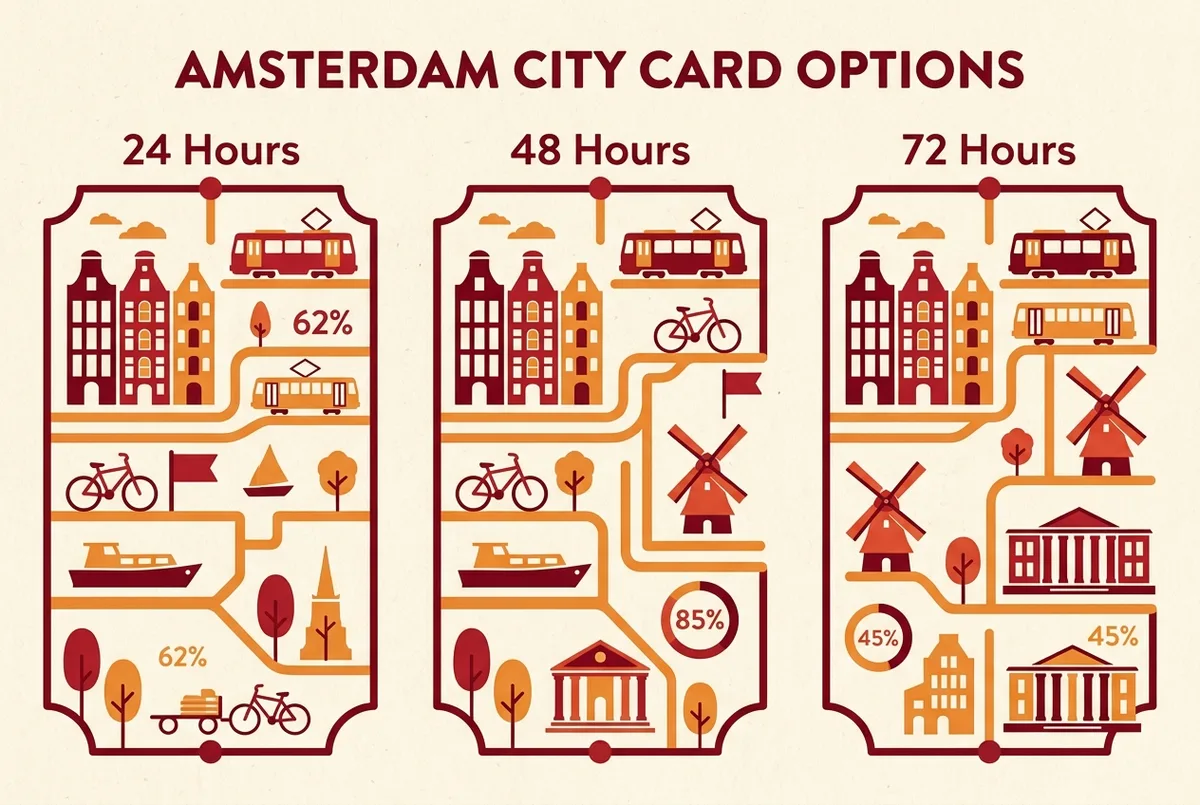
What is the decision tree by trip length?
A single day in Amsterdam, everything else is transit or another city: the 24 hour amsterdam day pass fits, provided you commit to three or more attractions from opening time.
A weekend, two full sightseeing days: the 48 hour card matches the pace and gives you two mornings without racing a shorter clock.
A long weekend or short city break, three full days: the 72 hour card is the most popular length for exactly this reason, comfortable pacing across three days without paying for a fourth you will not use.
Four sightseeing days: the 96 hour card extends the same logic, useful if your trip genuinely has four active days rather than three sightseeing days plus a slow travel day.
Five or more sightseeing days, or a very packed itinerary: the 120 hour card is the longest official tier, worth it only if your pace truly holds for the whole window. → See current availability
Does amsterdam city card 3 days mean three calendar days or 72 hours?
It means 72 consecutive hours from your first activation, not three calendar days on a fixed clock. Activate a 72 hour card at 2pm on a Tuesday and it runs until 2pm on Friday, which can straddle four different calendar dates depending on your start time. This distinction matters most for early or late activations: starting first thing in the morning gets the most out of each calendar day, while an afternoon activation stretches your coverage into a partial extra morning at the end.
How do I choose between 48 hours amsterdam and a longer card?
Count your planned sightseeing days honestly, including travel days where you will do little more than check in and find dinner. 48 hours amsterdam works well for a genuine two day sightseeing window: arrive, settle in, then two full days of museums and trams before departing. If your trip includes a slower half day, a day trip out of the city, or extra time simply exploring neighborhoods on foot without paid attractions, that day does not need to be inside your card’s validity window at all, since the card only needs to cover the days you are actively using it.
What if my sightseeing days are not consecutive?
This is the one hard limit of the official card: validity runs on one continuous block of hours, so a plan with sightseeing on day one, a rest day, then more sightseeing on day three does not split cleanly across a single card. In that case either buy a duration long enough to cover the whole span including the gap, or activate a shorter duration only on the days you actually need it and pay for individual tickets on the rest day instead. Run both scenarios through the break even math before deciding, since a longer card covering an idle day can sometimes still beat two separate short cards.
Only if you use every day of it. A 120 hour card used for three genuinely active days performs worse per euro than a 72 hour card used for the same three days, because you are paying for two days of coverage you never activate any value against. The rule that keeps the math honest: match the duration to your actual planned sightseeing days, not to your total trip length, and let the worth it verdict confirm the break even point for whichever tier you land on. When you are ready, the buying guide covers where to purchase and how activation works. → Check dates and prices
What is the best duration for most first time visitors?
For most first time visitors on a standard city break, 72 hours is the sweet spot: long enough for six or seven attractions at a humane pace, short enough that you use it intensively rather than letting hours go idle. Families and slower travelers sometimes prefer 96 hours to spread the same list across a gentler schedule, while efficient sightseers who front load their days sometimes get everything done inside 48 hours instead. There is no universally correct answer, only the one that matches your own pace. Public holidays can also reshape opening hours around your dates, so it is worth checking the Netherlands holiday calendar on Wikipedia before you lock in a duration around a specific week.
The City Card Amsterdam homepage lines up every duration and every competing pass in one comparison table if you want the full picture before you decide.
Frequently asked questions
What is the shortest amsterdam day pass I can buy?
The 24 hour version is the shortest official duration, best suited to visitors with a single dedicated sightseeing day and a plan for three or more attractions.
Is 48 hours amsterdam enough for the main museums?
Yes, for two of the headline museums plus a couple of smaller stops and full tram access, 48 hours comfortably covers the city’s main highlights at a relaxed pace.
Does amsterdam city card 3 days mean exactly 72 hours?
Yes, the three day tier runs for 72 consecutive hours from your first activation, not three separate calendar days, so plan your start time to maximize daylight coverage.
Can I extend my card if I run out of time?
The official duration tiers are fixed, so if you need more time you would purchase a new card or separate tickets for the remainder rather than extending the existing one.
Which duration gives the best value per euro?
Whichever one you use fully. A shorter duration used intensively often beats a longer one with idle days, so match your pick to your real itinerary rather than assuming longer always wins.
Ready to visit?
Book your tickets in advance: popular time slots sell out.